In this research proposal I will be covering some designs and plans for my final production piece using one of the technologies that I have explored previously. I will be considering different approaches for my final piece and deciding which plan I would decide to go for, using a variety of different sources as inspiration.
Research Overview
In this section of the proposal I will lay out what I will be doing and discussing the overall the scope of my project.
Project Ideas
Like I mentioned in the lab exercise blog posts, I have quite a few ideas in mind in terms of what I will make for my final project. A few of my ideas involving my Wendigo creature model were horror experiences made using either Maya or Adobe Aero to make a 360 VR video or an AR immersive experience respectively. The reason as to why I had those ideas is because I took heavy inspiration from the various horror experiences that you can find in those platforms, such as the various siren head 360 VR horror experiences you can find on YouTube (such as the various handmade horror videos depicting the user in a forest whilst being followed by something/someone) or FNAF AR (Illumix, 2019) which is an interactive horror game made through AR software.
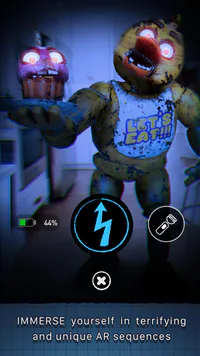
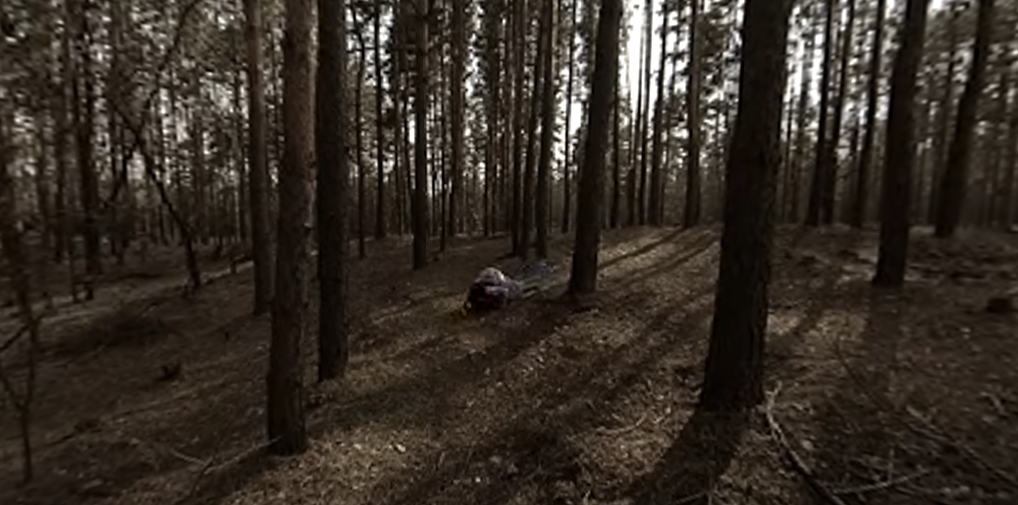
(HANDMADE-HORROR, 2021b)
However, one of the reasons as to why I did not decide to purse this route is because it has become oversaturated in the recent years, as there are a lot of VR 360 forest or haunted house horror experiences out there on YouTube and other sites. Another reason as the why I did not pursue this is because horror experiences in VR and AR can be quite intense for a lot of viewers, especially newer viewers who have never experienced close and personal jump scares before, and I want my experience to be inclusive for newer and more experienced viewers alike.
I also had some ideas on creating VR immersive art but quickly decided against that since I did not have a solid basis on what I was going to do for those. One of those ideas was to create a fictional forest environment using open brush or gravity sketch, with reference to my Wendigo character that I made last year. If I did decide to continue with that it probably would have been more light hearted in style in comparison to my horror ideas, so with brighter lighting and colours.
Final Project Idea and Target Audience
From the ideas that I have discussed in the lab exercise blog posts, I decided that the best option would be to do the 360 VR underwater video for my final project, which is an idea that consists of prehistoric sea/ocean creatures in an appropriate underwater environment. There are a lot of similar projects to it on YouTube in particular, like WULFI’s “VR 360 Diving” video which mostly consists of the camera moving around the environment, allowing the viewer to explore the surrounding area whilst also spotting various sea creatures including sea turtles, whales and various types of fish. There are also various underwater 360 videos which are also horror experiences, notably MVR’s terrifying sea creatures video, which utilises both aspects of horror and underwater 360 VR pretty well.
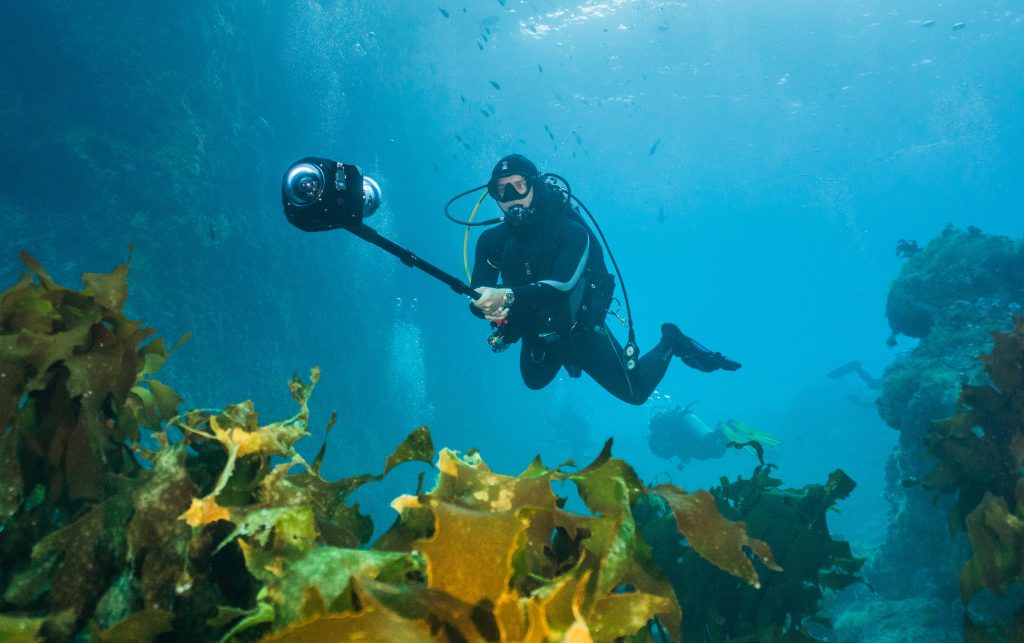
My project will differ from all those listed above as firstly it will feature prehistoric/ancient creatures and environments rather than the mostly common modern and fictional creatures and environments and secondly I want to make this slightly more educational and spark some curiosity to those who do not know much about that time period.
For this experience I thought of targeting an audience that has a limited knowledge of prehistoric ecosystems but would like to know more, by showing them this I could teach them in a visual way without the requirement of a book or mountains of text as they would often have to do. Usually, an audience’s expectation when watching an informative piece of media is to gain knowledge on the area that they decided to watch about. For example, when watching something in relation to the roman empire the audience would want to know about the events that transpired during that period. So therefore I will satisfy that need to know more by delivering it in an engaging manner.
Tools that I will use
In this specific VR 360 video I will most probably document the Cambrian period (happened 541-445 million years ago), which is an era known for its bizarre wildlife and ecosystems. Therefore I would most likely need to gather several Cambrian creature 3D assets from online sources, preferably with animations or at the very least having decent topology (all polygons being quads) so that the models would be easy to animate and therefore saving a lot of time. The following creature and plant models would be useful for me: Hallucigenia, Anomalocaris (or at least a close relative), Opabinia, Vetulicola, Xianguangia, Myllokunmingia, Eoredlichia, Wiwaxia, Onychodictyon, some coral assets and most probably more.
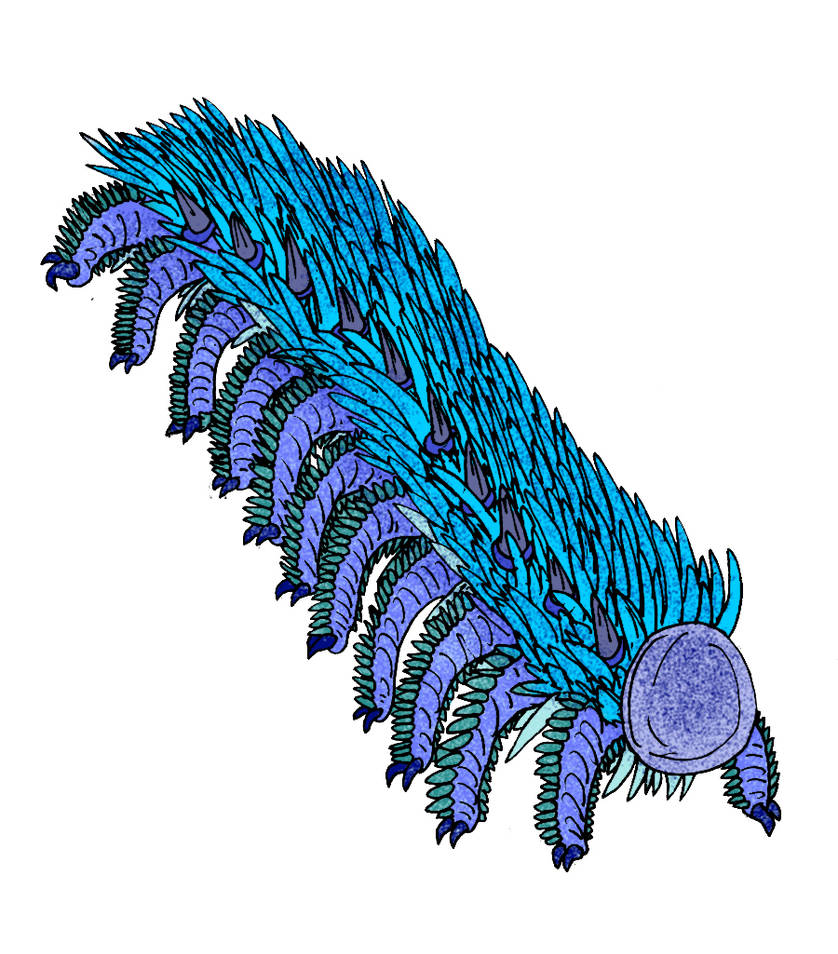
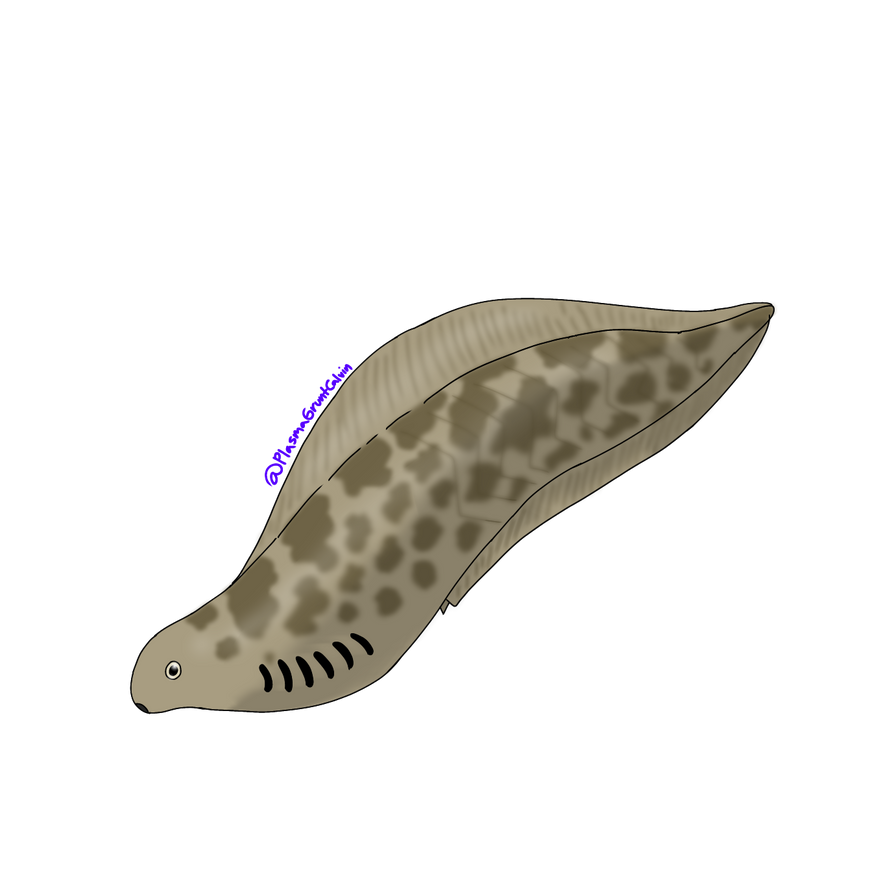
(PlasmaGruntCalvin, 2022)
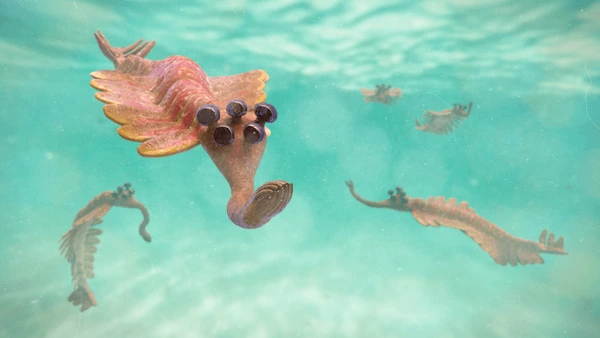
Also, I’m deciding to use Unreal for this project since Maya does not seem to allow for smooth camera movement during 360 video production. Since Unreal does not have any naturally built in options for 360 videos I will be using a plugin called Off World which is a leading choice in terms of making 360 content for Unreal. Another reason as to why I would prefer using Unreal is because it can simply handle more assets in the scene, since I will be using duplicates of each asset that I gather in the scene, which will be resource heavy if I use it in Maya. Finally, Unreal has better options in terms of effects than Maya. Despite Maya having MASH, unreal has more options in terms of effects such as post processing objects or the Niagara system so I could create a more smooth experience as opposed to messing around with MASH, which I do not know as much about as opposed to the Niagara system. I will still consider Maya as a secondary option though in case my tests in Unreal do not turn out how I want them to.
Visual Style and Narrative
For the visual style I was thinking of making the project look more realistic rather than stylised, this is because I am trying to keep this as an informative experience rather than a fictional one. Therefore, the visual style is going to be quite similar to that of popular dinosaur documentaries, such as Planet Dinosaur (BBC One, 2011) and Prehistoric Planet (Apple TV+, 2022) with a slightly dull colour palette to match my realistic vision for the project. These often blend real locations with CGI effects but like I said I will use 3D models on an environment that is based on a real location. My project will differ from those documentaries as I will not be using cgi to make my experience, but rather put 3D models into a scene in either unreal or maya.
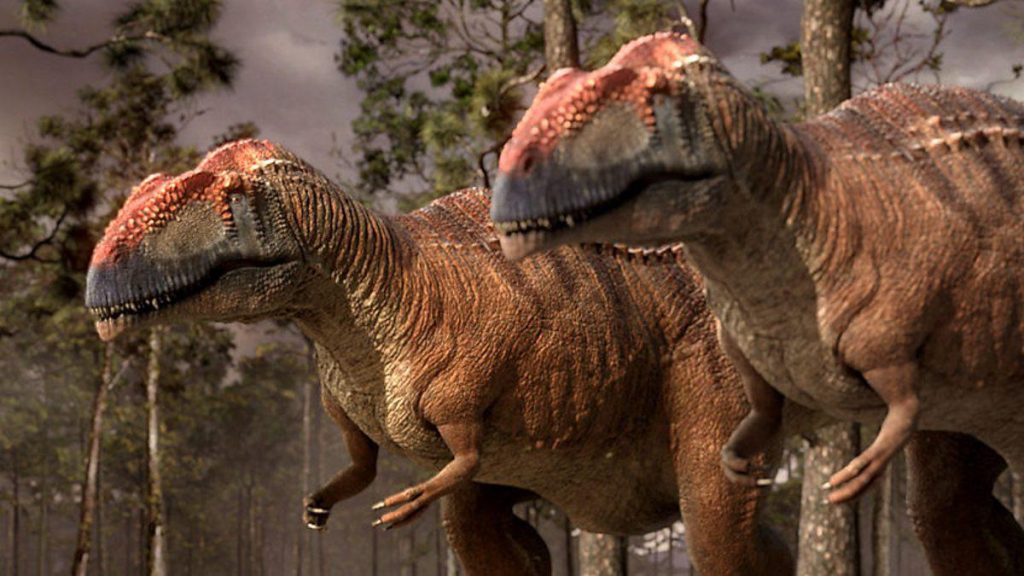
(Darth_Summit, 2021)
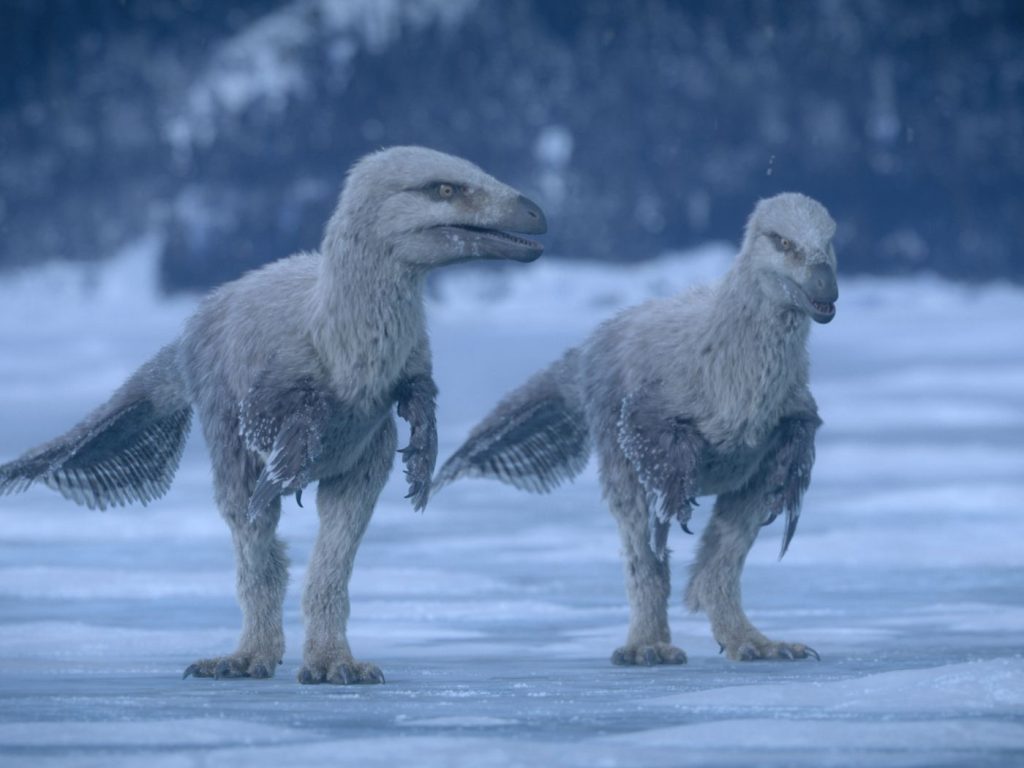
(Webster, A., 2023)
The overall narrative of this project will be based upon the Cambrian period (roughly about 518 million years ago) as described earlier and will take place in what is now known as the Chengjiang formation in China. To add further context to this location, this is one of the most important fossil sites in the world due to it containing some of the earliest fossils of complex life in this planets history, with the likes of Myllokunmingia, Onychodictyon, Eoredlichia and many other lifeforms.
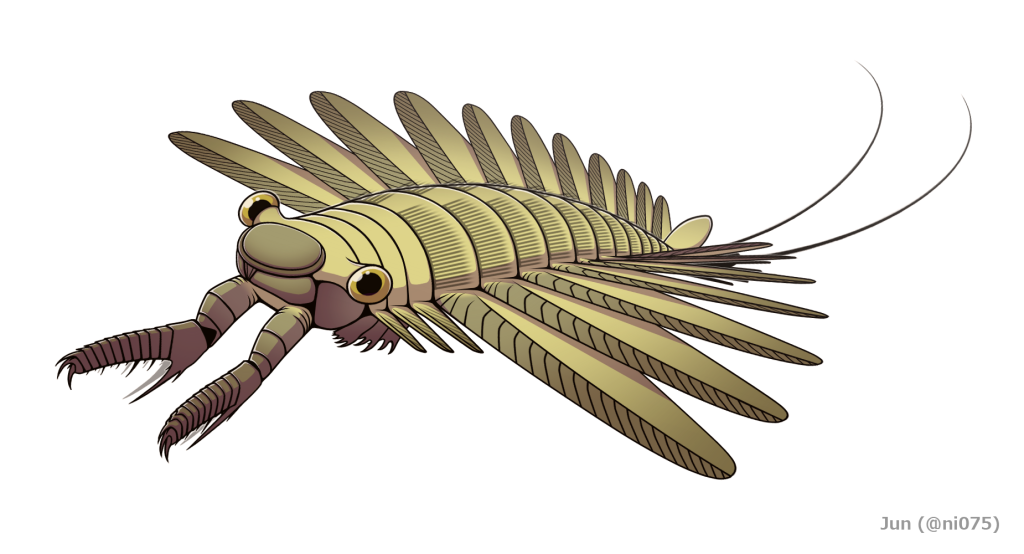
(Junnn11, 2019)
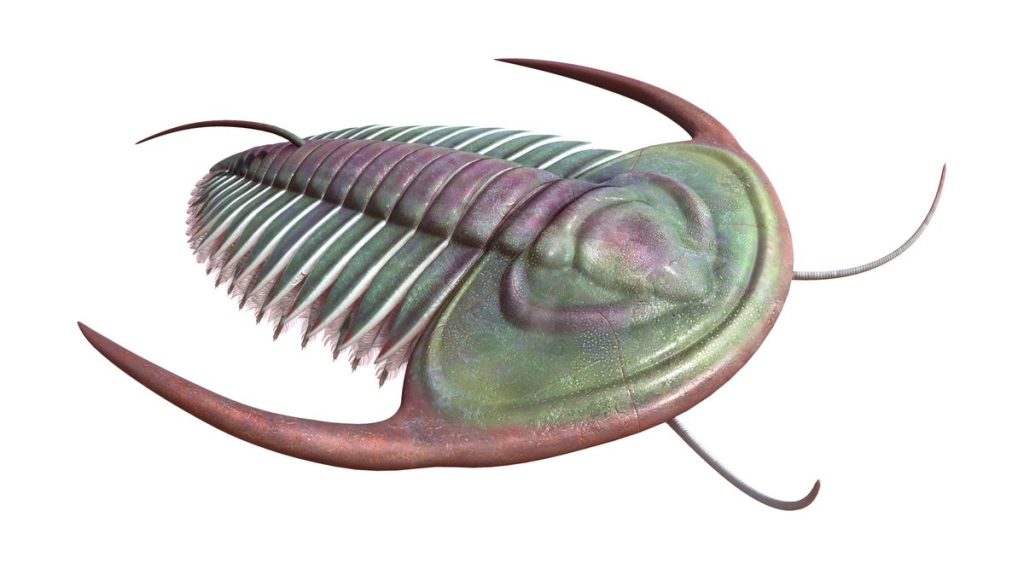
(Oxford University Museum of Natural History, 2019)
The start of this experience will take us through groups of Myllokunmingia, which is often regarded as one of the earliest known fish (Benningfield, D., 2023) whilst also adding some extra information alongside this, following that the experience will take us to a predator known as Amplectobelua (a relative to Anomalocaris) which like Anomalocaris was regarded as an apex predator in its turf. The viewer will then stay near where the Amplectobelua is whilst the experience tells them some facts about that. Following that, the viewer will be lead to the bottom after which there will be more introductions to various species and more information surrounding them. The experience will end with a still shot of the environment slightly zoomed out whilst there is an explanation on the Cambrian extinction event and how it came to be.
Ethical Considerations
Since I have discussed what I am planning to do I will now discuss about the multitude of different ethical considerations that I would have to take into account. The first and most obvious consideration is the factuality of the information that I will give to the viewer. A lot of the issues that come with informative media is that a lot of it turns out to either be misleading, outright wrong or outdated. Of course one cannot prevent information to be outdated in the world of palaeontology since the experts keep debating over these things and there can be new evidence to suggest a totally different lifestyle for an animal (for example, experts continuously debate over whether Spinosaurus was a fully aquatic or semi aquatic predator). However, misleading or outright wrong information can make people oblivious to actual facts regarding these subjects, hence why it is important for me to base my information on multiple sources.
Since my project is a 360 VR video, it is also important for me to consider about the user themselves and how they would react to this content. The first issue is of course, accessibility, not everyone has access to a VR headset as it is fairly expensive to buy one so to tackle that I will make this project available on YouTube for more people to access it. VR 360 tends to also have a problem in regards to accommodating people with visual and hearing impairments, as well as people with mobility issues, which could be a problem for my task at hand but unfortunately there is not a lot one can do to nullify this as of now. Since 360 videos film everything around them, there is a possibility that I could film something that I intend not to film, so to prevent that from happening it good to have a plan for this or put in visual cues for the viewer to know where they should pay attention to. The final consideration that I would like to discuss is that social norms and laws have yet to catch up on the VR 360 technology, so there are concerns in regards to production and presentation of these videos (INCA Summer, 2020). In order to combat this, I will try to present my work as professionally as possible and ensure that the experience is safe and enjoyable for everyone who wants to give it a try.
Other general ethical considerations include making the experience accessible to a wider audience, like making visuals for the deaf and acknowledging those who can experience epileptic seizures whilst viewing flashing lights. Therefore, in order to combat this I will have to put warnings at the beginning of the sequence to warn those viewers so that they are aware of what they are getting into.
Testing and Prototyping
In this section I will document the feedback and recommendations that I got whilst making a rough prototype for my project. I made a quick test project in Unreal to see how my project would look like, so I created a quick scene using the landscape tool, followed by the imports of the assets that I downloaded into unreal. This turned out to be pretty simple to do, however there might be issues down the line when it comes to adding more animations into the scene. This is probably something that I could figure out throughout the production of the experience but it would be something that I would have to bear in mind when going through with the final project. After that I made some quick effects using the volumetric cloud, post processing volume and sky atmosphere to create something that resembles an underwater effect. However, I will have to apply the post process volume effects to the camera as it does not show whilst the camera is recording
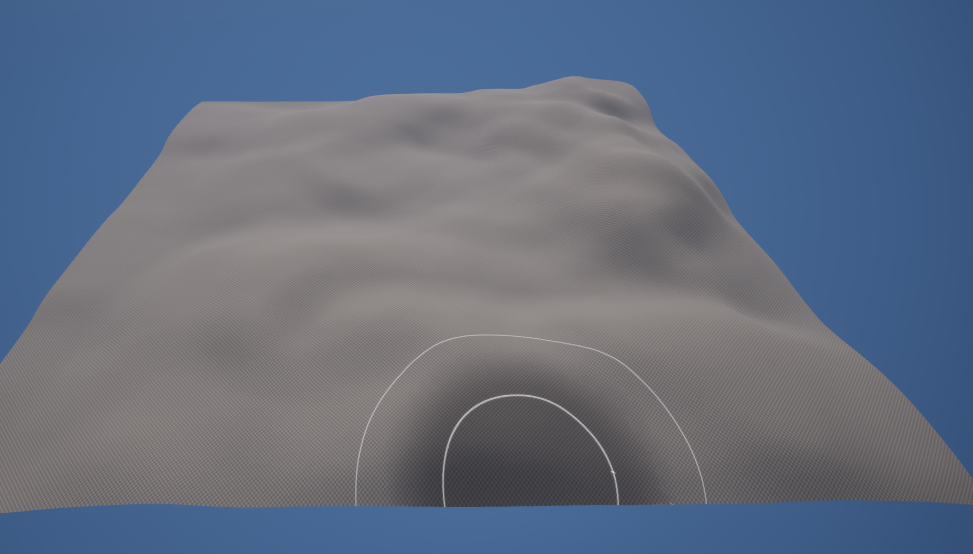
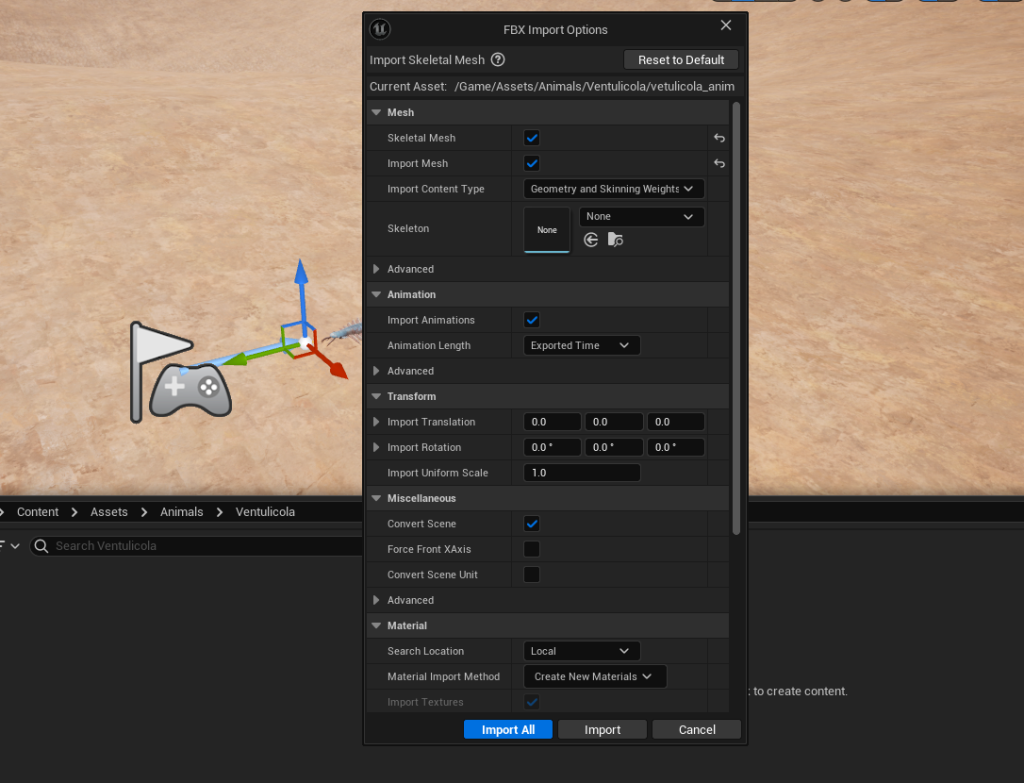
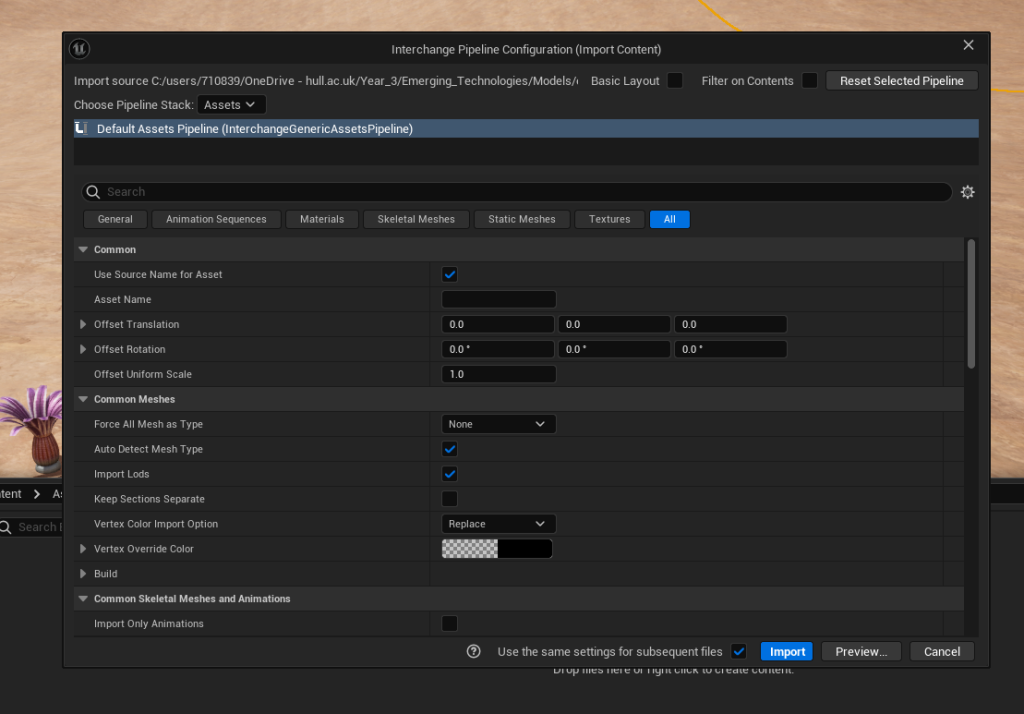
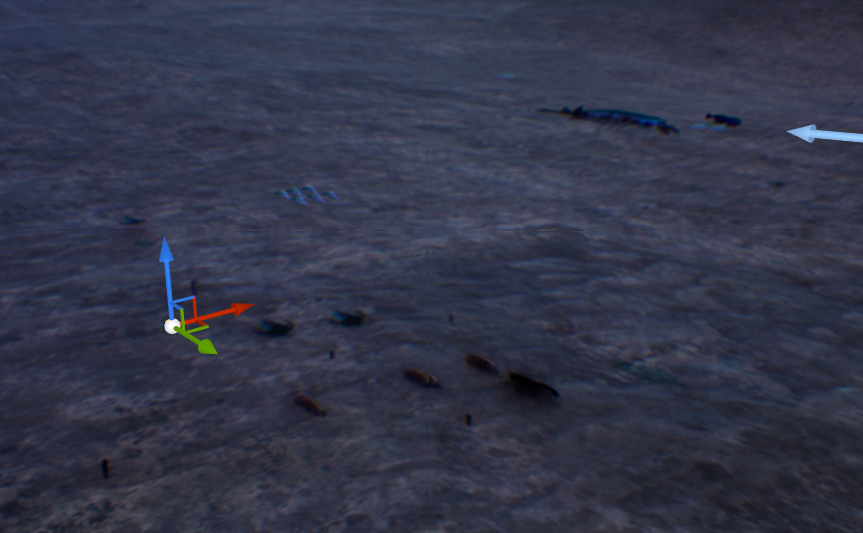
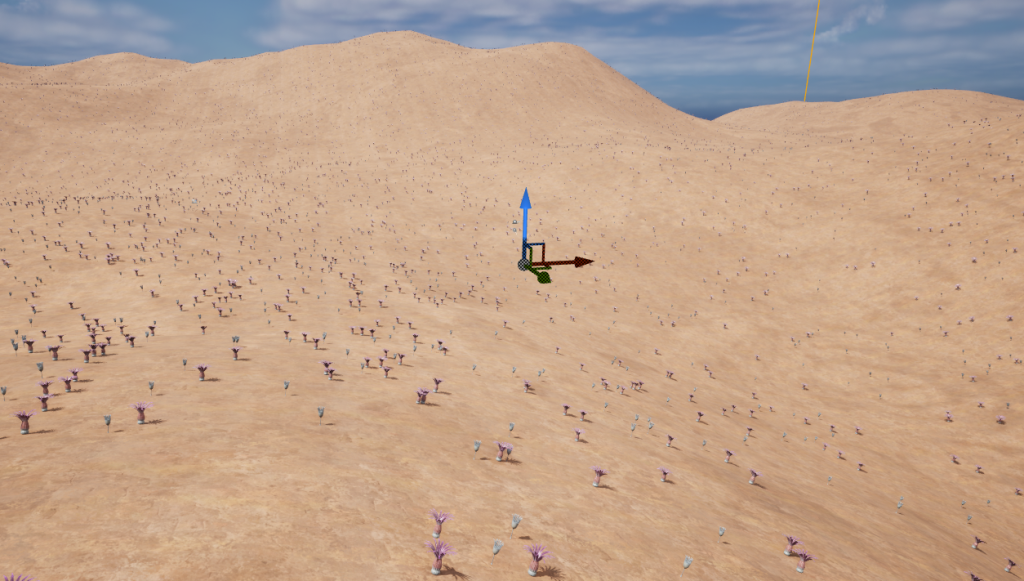
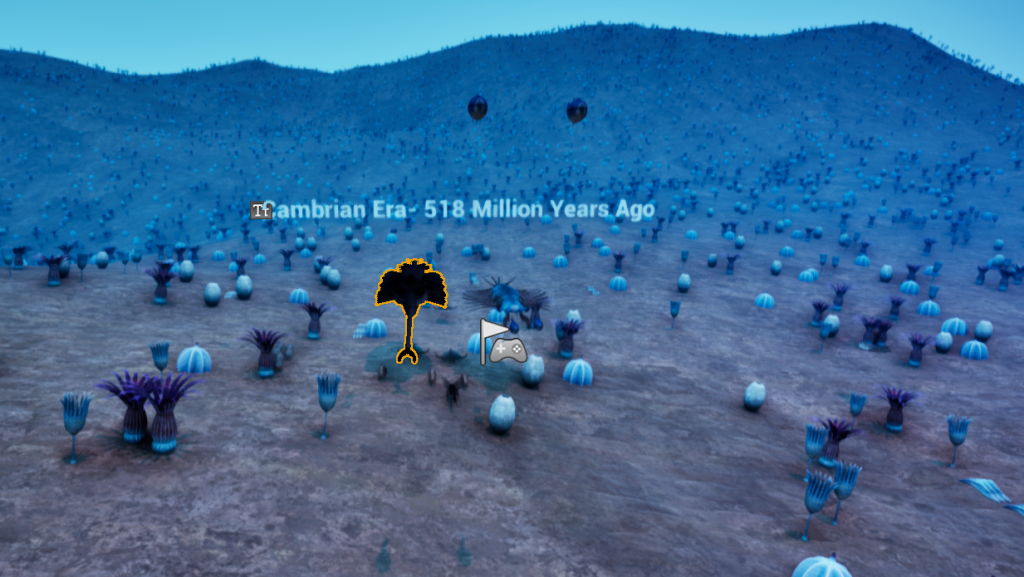
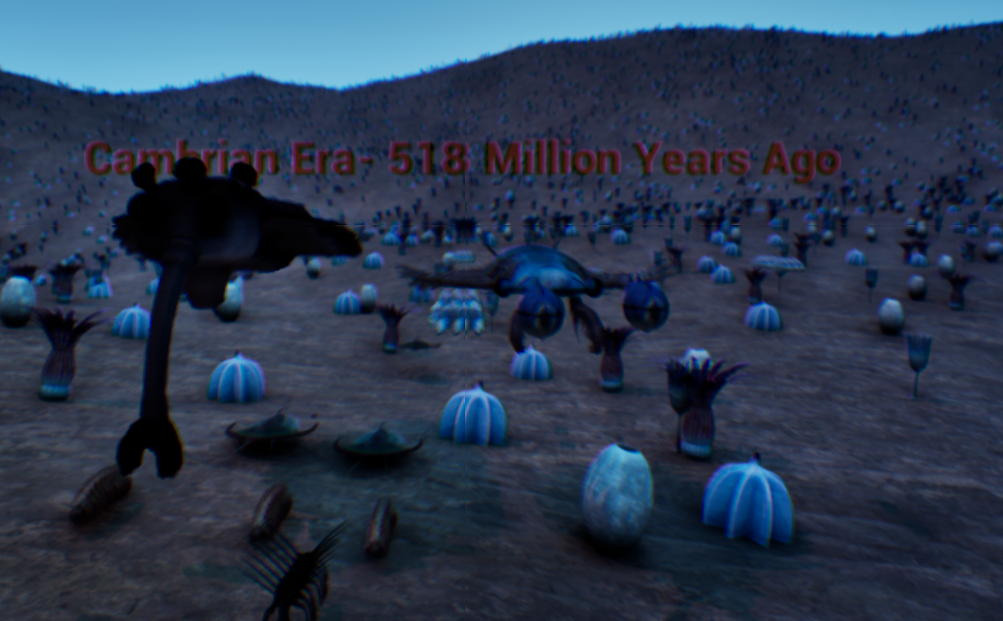
Most of the feedback for this project was mostly positive, though I had some suggestions to make this an AR experience since it would be more interactive, but I ended up picking the 360 video route instead since I can design the environment around the experience so that the viewer would be more immersed.
Project Plan
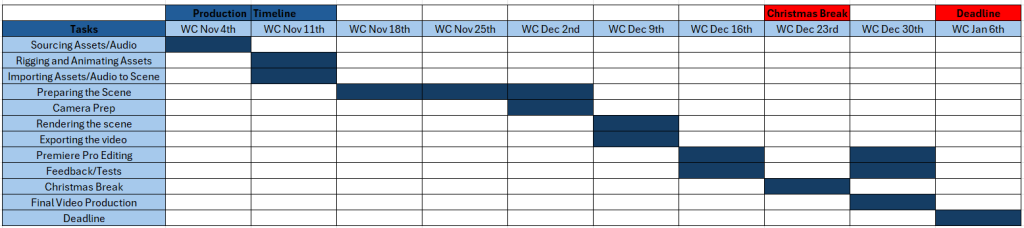
For this following section, I would like to outline my plans for the following emerging technologies project. Since I am definitely going to start during the week after the hand in of this proposal, I am considering to split the tasks accordingly to the dates and against other tasks that I would have to do during this time. As you can see below, I created a Gantt Chart to ensure that I am up to date with my tasks for each week. A Gantt Chart is a project management tool that shows the different tasks that someone will do or has done in relation to the time that it might take them to do so (Meardon, E., 2019). These charts can also show milestones like the one I made below to make it easier for an individual to understand them.
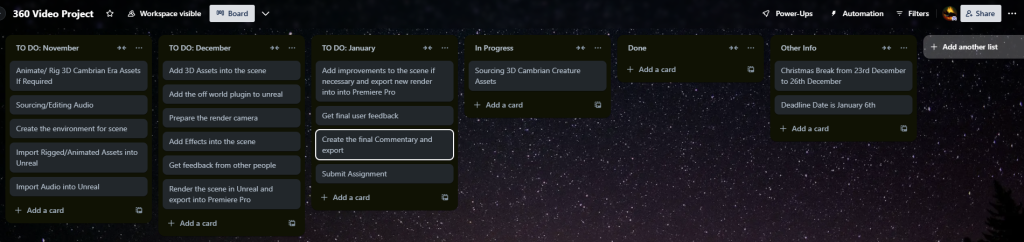
The other project management tool that I will be using is Trello, this project management tool is another visual tool that makes it easier to manage project workflows and task tracking. It allows users to add checklists, images and automation in the task lists to keep things up to date (Trello, 2019). Trello also allows me to add more details to my overall project plan than the Gantt Chart so I know exactly what I nee to do. In my Trello board I included to do lists, an in progress list and a done list to keep tasks up to date in a checklist like manner.
Concept Storyboard
This final section of the research proposal is a visual representation of the concept that I discussed earlier. This storyboard will include lighting and audio information in addition to any information in regards to the shot in particular (eg, timeframes and description of the shot).

Frame 0 – This is an introductory frame that will give disclaimers to the viewer before the sequence starts. There will be a fade into the first frame after this. Sounds: underwater (will fade in slowly), music (will also fade in).


Frame 1 – The viewer will be introduced to scene with a group of Myllokunmingia on the right and a group of Xianguania on the left. There will be text introducing the viewer to the time period as well as text near Xianguania labelling some facts about them. Sounds: movement underwater, bubbles, animal sounds from distance. Lighting: directional light, sky light. Effects: particles emitted from animals, fog, underwater ripple effect, sand particles, blurred shadows.
Frame 2 – The text will then highlight the group of Myllokunmingia as well as some facts about the species. The camera will be following the Myllokunmingia whilst this is happening. Sounds: underwater movement, animal sounds from distance, music, ambience. Lighting: directional light, sky light. Effects: particles emitted from animals, fog, underwater ripple effect, sand particles, blurred shadows.


Frame 3 – The camera will keep following the group of Myllokunmingia whilst also showing a new species called Amplectobelua as well as text to label what it is. This Amplectobelua will follow the group of Myllokunmingia, searching for a meal. Sounds: underwater movement, music, ambience. Lighting: directional light, sky light. Effects: particles emitted from animals, fog, underwater ripple effect, sand particles, blurred shadows.
Frame 4 – The camera will focus on Amplectobelua whilst it catches one of the Myllokunmingia that the viewer followed earlier with its front appendages. Text will then appear that will label some facts about Amplectobelua. Sounds: underwater movement, music, claw grab, ambience. Lighting: directional light, sky light.Effects: particles emitted from animals, fog, underwater ripple effect, sand particles, bubble effects following the catch, blurred shadows.


Frame 5 – After that the camera will then slowly catch up with the group of Myllokunmingia that it followed earlier, as well as showing some more new species in the background, as well as the environment surrounding these species. Sounds: underwater movement, music, ambience. Lighting: directional light, sky light.Effects: particles emitted from animals, fog, underwater ripple effect, sand particles, blurred shadows.
Frame 6 – The camera will then stop for a bit allowing the viewer to look around the environment, with text over various different species that appear. Sounds: underwater movement, music, ambience. Lighting: directional light, sky light. Effects: particles emitted from animals, fog, underwater ripple effect, sand particles, blurred shadows.


Frame 7 – After the set amount of time is up the camera will continue moving to another segment where the viewer can observe more species as well as their behaviours. Sounds: underwater movement, music, ambience. Lighting: directional light, sky light. Effects: particles emitted from animals, fog, underwater ripple effect, sand particles, blurred shadows.
Frame 8 – Following the previous scene, the camera will zoom out from the scene a little, until it stops. After that some text will appear that will mainly talk about how these species went extinct. Sounds: underwater movement, music, ambience. Lighting: directional light, sky light. Effects: particles emitted from animals, fog, underwater ripple effect, sand particles, blurred shadows.

Frame 9 – There will be a fade to a thank you screen, followed by a fade to black, concluding the sequence. Sounds: underwater (will fade out slowly), music (will also fade out)