In this week I was learning about the importance of anatomy when creating a character. A basic understanding of human anatomy is important as the character design will feel unhuman and unnatural. When drawing the character, the structure and movement of muscles is important (as you to know how the human body works), and a knowledge of basic muscle groups is an easier way to remember this instead of having to memorise each and every muscle in the body.
Proportion
Proportion is also a very important factor to consider when drawing a character, like the 8 or 7 1/2 head rule which is basically taking the size of the head and stacking 8 of that measurement to get the full height of the body. Other proportion examples include the shoulder width being 3 heads for a male character and 2 heads for a female character, the elbow being just below the ribcage and the pelvic bone being located at the mid-point of the body. However, there are several factors that affect proportion, such as age and gender. For example, the head rule changes when it applies to children as they have larger heads than adults and generally having less fat, in adolescents, puberty related aspects are more visible compared to children but not as much as in adults and the elderly often have larger noses and ears, more wrinkles and more a more visible skull outline compared to younger characters. However, these rules do not always apply, such as in cartoons where proportion is not the main concern.
Gesture Drawing
I also learned about gesture drawing, which is basically a loose form of sketching which shows off movement, action and form of a character through using the minimum number of lines (1). This is used to convey emotion and liveliness to your character rather than them looking stiff and robotic. The differences in drawing a character using structure(anatomy) and gesture is that the structure is stiff and robotic, potentially having a lack of personality and also being anatomically correct, while gesture is normally used to convey emotion, movement and energy with not much thought over anatomy and detail in the process.
Process of creating a character (using anatomy)
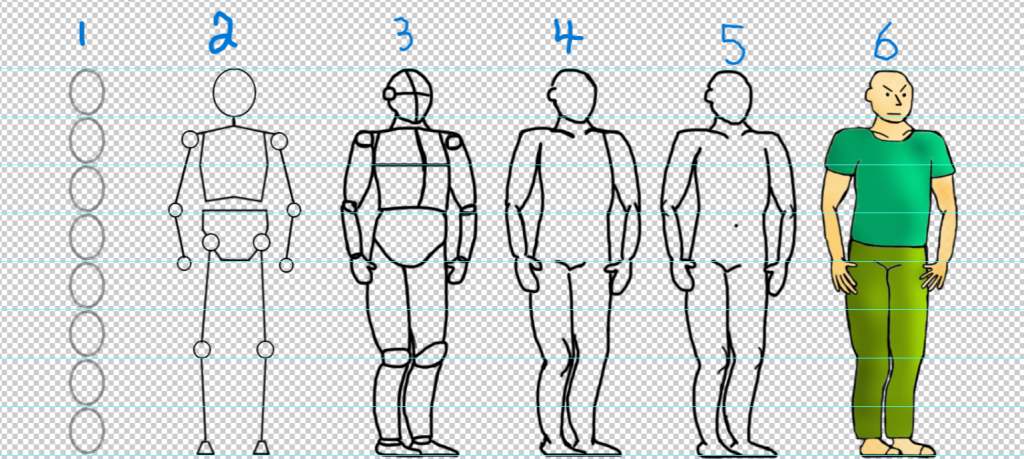
Firstly, I started off by creating a brand new photoshop document with a size of 1080 by 1920 pixels and made the background transparent. After that, I started by going to the edit tab and to preferences and chose grids and guides. I wanted to put guides on my project since I would need them to stack the heads and get the body proportion right. Then, I made my head and duplicated it until I got about 8 oval like heads and stacked them on top of each other. After I finished with the head stacking, I merged them into one layer, duplicated the newly merged later and moved it slightly so that I could carry on with the next stage of the anatomy drawing, for which I just basically drew out the places where all the body parts would be located (elbows, arms, hands, legs, knees, feet, hips, ect). I decided to make an adult male character for my drawing, so I also had to keep that into account when making my character so that I do not get their proportions wrong, Afterward, I drew out the basic outlines of all the muscles and structures in the body, including the biceps, quadriceps, triceps, hamstrings, gluteals, pectorals, deltoid and gastrocnemius muscles (2). In the next two stages, I was refining the character a bit more to clear any editing lines and just to refine some of the physical attributes of the character, such as the elbows, ears and knees. For the final stage of my drawing, I just added facial features (eyes, eyebrows, mouth and nose) onto the character’s face, added fingers to their hands and of course added some accessories and colour to it as well.
Conclusion
Overall, I have learnt quite a bit throughout the creation of my character by using anatomy, and while it is not the best, I can actually get something out of this that I can use as a future reference if I want to recreate a character through such means. My knowledge on anatomy from college was definitely useful for this particular project as without it I would have needed to learn about all of the major muscle groups from scratch. However, since I did know how most of the muscles in the body work and how they look, I could use this knowledge for animation if I do come to do it in the near future. I had a massive development in being able to draw human like characters as I am normally not too great at drawing such characters and normally prefer to draw animalistic figures. I do still think that I need more development on being able to draw the hands as the hands did not turn out too great and I also struggled with drawing clothes onto my character, hence why it looks a bit odd if you pay attention to it for long enough. So, for next time, I will try and pay more attention to these small details if I come to make another character using this technique in the future.
Reference List
(1) South, H. (2019) Sketching 101: What Is Gesture Drawing? LiveAbout. Available online: https://www.liveabout.com/sketching-101-what-is-gesture-drawing-4125487#:~:text=Gesture%20drawing%20is%20a%20loose%20form%20of%20sketching [Accessed 2 Dec. 2022].
(2) Spector, R. (2018) The 13 Major Muscle Groups of the Body and their Functions. Elevate Nutrition. Available online: https://www.elevatenutrition.com/13-major-muscle-groups-body-functions/.